
I recently released AnimSprite Pixelizer on Booth, itch.io, and Steam — a tool for 2D game development that batch-converts hand-drawn character walk animations (created in tools like CLIP Studio) to a common pixel size and exports them as sprite sheets.

After completing the app, I decided to tackle localization as well.
The key question that comes up is: "Which languages should I localize into?" In this article, I'll analyze the "Steam Hardware & Software Survey" data that Steam publishes monthly to help indie and small-team developers decide which languages to prioritize.
Current Steam Language Data
According to the latest data from Steam's official "Hardware & Software Survey," the current language distribution among Steam users looks like this. While participation is voluntary, it remains the most reliable official statistic available for the Steam platform.
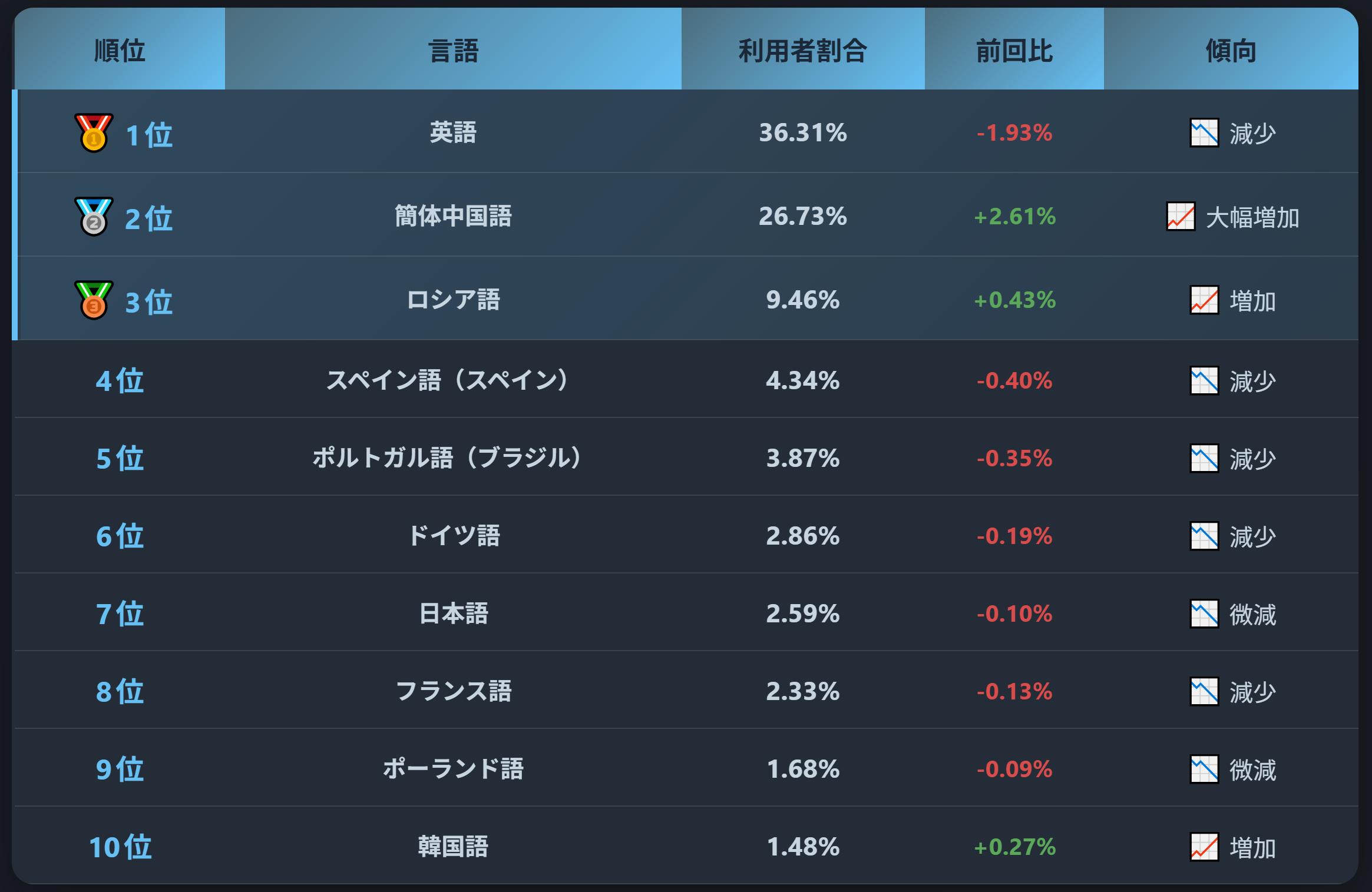
Steam Hardware & Software Survey: June 2025
Top 10 Languages and Market Trends
Here's the current ranking of Steam users by language:
| Rank | Language | User Share | vs Previous | Trend |
|---|---|---|---|---|
| 1st | English | 36.31% | -1.93% | Declining |
| 2nd | Simplified Chinese | 26.73% | +2.61% | Strong growth |
| 3rd | Russian | 9.46% | +0.43% | Growing |
| 4th | Spanish (Spain) | 4.34% | -0.40% | Declining |
| 5th | Portuguese (Brazil) | 3.87% | -0.35% | Declining |
| 6th | German | 2.86% | -0.19% | Declining |
| 7th | Japanese | 2.59% | -0.10% | Slight decline |
| 8th | French | 2.33% | -0.13% | Declining |
| 9th | Polish | 1.68% | -0.09% | Slight decline |
| 10th | Korean | 1.48% | +0.27% | Growing |
Key Market Trends
Growing language markets:
- Simplified Chinese: +2.61% (highest growth). Likely driven by the maturing PC gaming market in China.
- Russian: +0.43%. A market known for strong affinity with indie games.
- Korean: +0.27%. A market with passionate gaming communities.
- Traditional Chinese: +0.07%
- Thai: +0.07%
Declining language markets:
- English: -1.93% (largest decline)
- Spanish (Spain): -0.40%
- Portuguese (Brazil): -0.35%
- German: -0.19%
Japanese users account for just 2.59% — a reminder of how vast the global market is.
The most noteworthy insight is that English and Simplified Chinese combined cover over 63% of all users. If you're going to localize, supporting these two languages is practically essential.
Simplified Chinese users have been surging in recent years. In the August 2024 survey — driven by the massive buzz around "Black Myth: Wukong" — Simplified Chinese actually surpassed English to claim the top spot.
Localization Priority Rankings
Let's think about which languages to prioritize with limited development resources.

Tier-Based Priority Framework
Tier 1 (Essential)
- English (36.31%) — Still the largest user base and the global standard language
- Simplified Chinese (26.73%) — Rapidly growing with extremely high future potential
These two languages alone cover over 63% of users. For small teams and solo developers, focusing on these first is the most efficient approach.
Tier 2 (High Priority)
- Russian (9.46%) — Steady growth trend, large user base
- Spanish (Spain) (4.34%) — Declining but still a major market. Also potentially reaches the vast Spanish-speaking Latin American audience.
- Portuguese (Brazil) (3.87%) — An important South American market
Tier 3 (Medium Priority)
- German (2.86%) — Major European market
- Japanese (2.59%) — High purchasing power, quality-conscious market
- French (2.33%) — European and Canadian market
Tier 4 (Emerging Markets / Future Potential)
- Korean (1.48%) — Growing (+0.27%), well-developed gaming culture
- Traditional Chinese (1.39%) — Taiwan and Hong Kong market
- Thai (0.88%) — Growing Southeast Asian market
Phased Localization Strategy
For indie developers, a phased approach like the following is realistic:
- Phase 1: Your native language + English (developer's language + global standard)
- Phase 2: Add Simplified Chinese (target the largest growing market)
- Phase 3: Add Russian and Korean (capture growing major markets)
- Phase 4: Gradually add other Tier 2-3 languages (Spanish, Portuguese, etc.)
Practical Implementation Tips
Font Support
Chinese, Korean, Japanese, and Thai each require dedicated fonts. Check in advance whether web fonts or system fonts will work, or if you need to bundle font files with your application.
Text Length Variation
Text length varies significantly across languages. UI design needs to be flexible enough to handle these differences.
- Tend shorter: Japanese, Chinese, Korean (logographic characters)
- Tend longer: German, Russian (compound words and grammatical cases)
Test your buttons and text boxes with longer text strings in advance to avoid overflow issues.
Documentation (FAQ)
Localizing your app means you may receive inquiries in various languages. Responding to every question individually is a huge drain on time. Prepare anticipated questions and answers as documentation, translate them into supported languages, and publish them. This lets users self-serve and significantly reduces developer support burden.
Right-to-Left (RTL) Languages
Languages like Arabic and Hebrew are written right-to-left (RTL) and may require flipping the entire UI layout. While these aren't in the top tiers currently, keep it in mind if you might support them in the future.
Designing for Localization from Day One
This analysis shows that ideally supporting the top 10 ranked languages would let you reach the vast majority of Steam users.
With generative AI tools like ChatGPT, Claude, and Gemini now available, high-quality translation is more accessible than ever. For UI and system text, AI translation alone can deliver quite good results. Of course, for story text and character dialogue that affect immersion, professional translators or native speaker review is still recommended.
The key takeaway is to design for localization from the very start of development.
Instead of hardcoding text directly in your program, load it from per-language CSV or JSON files. This makes adding new languages later much easier.
There are considerations like font preparation and UI design that prevents layout breakage from text length changes, but the implementation barrier is steadily dropping thanks to AI advances. If you're aiming for the global market, I encourage you to consider localization seriously.